

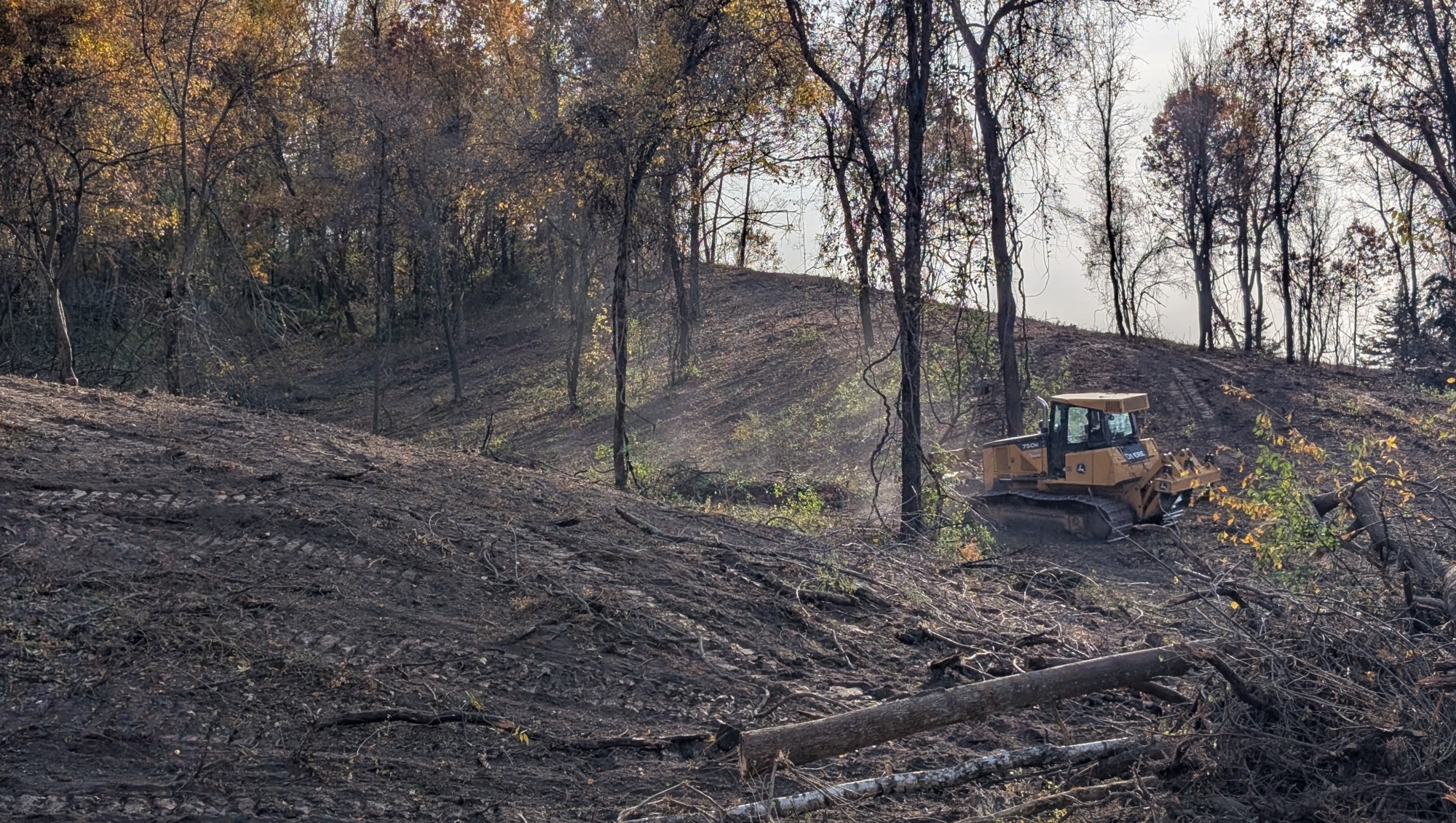
In this post I will describe some of the kinds of specialized heavy equipment that we use on larger, acreage-scale projects. It is important to note that every type of equipment, and every kind of management practice has its own strengths and weaknesses. I find the economist Thomas Sowell’s quote quite applicable within many aspects of my work (and life in general for that matter):
“There are no solutions. There are only trade-offs.”
It is valuable to weigh these tradeoffs constantly in order to do both the least harm, and the most good. Different contexts, site conditions, plant communities, and site objectives may benefit from the use of varying approaches.
Many consider the use of heavy equipment to be too ‘heavy handed’ for their liking, and it’s sometimes difficult to argue with them. There are certainly cases to be made for working at a small scale, intimately in tune with your ecology, working patiently toward your objectives. There can be a bit of an attitude of domination and control associated with using large, powerful, destructive technologies in a way that allows us to psychologically separate ourselves from the microcosms we are upsetting. The hope would be that our more personal interactions with these ecosystems might be maintained during implementation, and that the results of our efforts may prove our more extreme actions worthwhile. How one responds to bird nests, or the multitude of scattering creatures while operating equipment may be telling.
As we have stated before, Restoravore is about integrating ourselves with the local ecology, not simply attempting to command and control it.
Even with the negative aspects of the more heavy-handed approaches, I find it difficult to argue against the economics and the results. Even a disturbed, torn-up site marked with equipment tracks, ruts, and scattered burn pile scars can very quickly become a spectacularly diverse and functional ecosystem. I find that one can often improve and rebuild habitat at a pace substantially greater with these tools than without. A few years down the road, how much will the diversity of species that are living in these spaces care about which practices were used? Will the ends justify the means? And with the current pace of biodiversity loss we are seeing every year, might we have a responsibility to work as quickly and efficiently to preserve and rebuild as humanly possible. Might ‘doing the least harm’ actually mean working as quickly as we can?
Forestry Mulchers
Most commonly a skid-steer mounted attachment, a forestry mulcher is a cylindrical drum grinder with carbide teeth. Forestry mulchers can be used to clear brush and small trees extremely rapidly. These days it seems there are plenty of operators around and I’d be surprised if you had a difficult time finding one locally. These machines are not something that you can typically rent and use yourself. They require reinforced cabs with near bulletproof glass. They take a beating, are complicated and expensive to repair. Many rental agencies don’t bother to manage them. Agencies that do offer them for lease require users to have substantial rental insurance policies. In spite of being a contractor myself, I still find it preferable to hire this type of specialized work out. I have multiple good operators in my area that I get along with quite well, and who work efficiently.
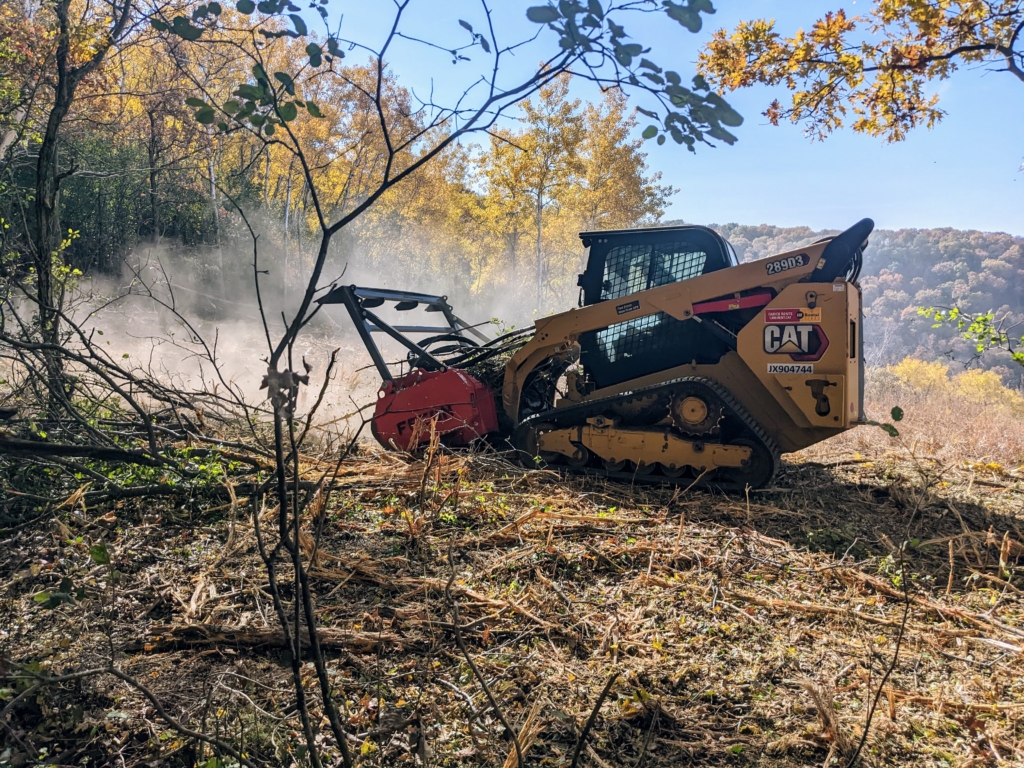
Mulching isn’t inexpensive, but it can sure save you a ton of time and energy. I find that most of my clients are so impressed with the efficiency of forestry mulchers that they often choose to increase their project scale while the equipment is on site. These landowners are usually aware of just how much time it would take for them to clear their land using other methods. They often regret not hiring an operator sooner.
I find mulchers practical with woody vegetation up to about 4” in diameter. They can take on some larger timber, but with reduced efficiency. They will handily pulverize fallen and rotting timber obstructions, but can have a difficult time navigating steep, or really rocky environments (rocks aren’t great even on carbide teeth). One drawback of forestry mulchers is that they tend to leave all of the larger trees. Some of the remaining trees may be desirable, but it is often the case that many of these trees will need to be removed or girdled to allow more sunlight to reach the ground in a more open canopy. One may need to commit to a few additional years of follow up work clearing some dead and dying trees. That said, as long as your functional ecosystem objectives have been met, some dead and downed trees may simply provide habitat and heterogeneity on a site.
One other drawback of mulching is that it can leave quite a dense layer of wood mulch on the ground. This material, if thick enough, can be problematic for seedling establishment, and can contribute to further nutrient loading. I find it appropriate to make an attempt to either incorporate the mulch into the earth with some sort of soil conditioner attachment, or to pile (and maybe even burn) it in a few sacrificial spaces. I once left the mulch layer intact and then returned for a summer prescribed burn. When the mulch ignited it became quite difficult to extinguish. In that case we decided to just let it burn and were eventually left with a very clean site with only ash remaining. That is not likely to be the most convenient practice on most projects, so I would generally recommend the former plan (mechanical removal).
Feller-Bunchers
When the budget allows, or when objectives require a more open and tidy site, free of excess wood mulch and dead standing wood, one can bring in some even larger equipment. You will all be familiar with excavators and bulldozers, both of which can be incredibly useful on large projects to push material, shape the ground, bury burn piles and correct large erosion problems. You may be less familiar with the feller-buncher. These machines are not very common in Southeast Minnesota. They are typically found further north in regions where more extensive logging operations are found, and where winter frosts run deep into the ground and persist longer. Frost often allows a longer work season with less soil compaction issues.
The feller buncher is a specialized logging machine usually mounted on a dedicated large loader or excavator. They specialize in grasping and cutting full sized trees, often also removing the tops and trimming them to sawmill lengths. Feller-bunchers can cut through even hardwood trees at near ground level, leaving only a short stump. This allows follow-up mowers and other equipment to travel through with few issues. Slopes and irregular ground can cause the machine to sometimes leave some higher stumps, but usually a site can be left impressively clean.
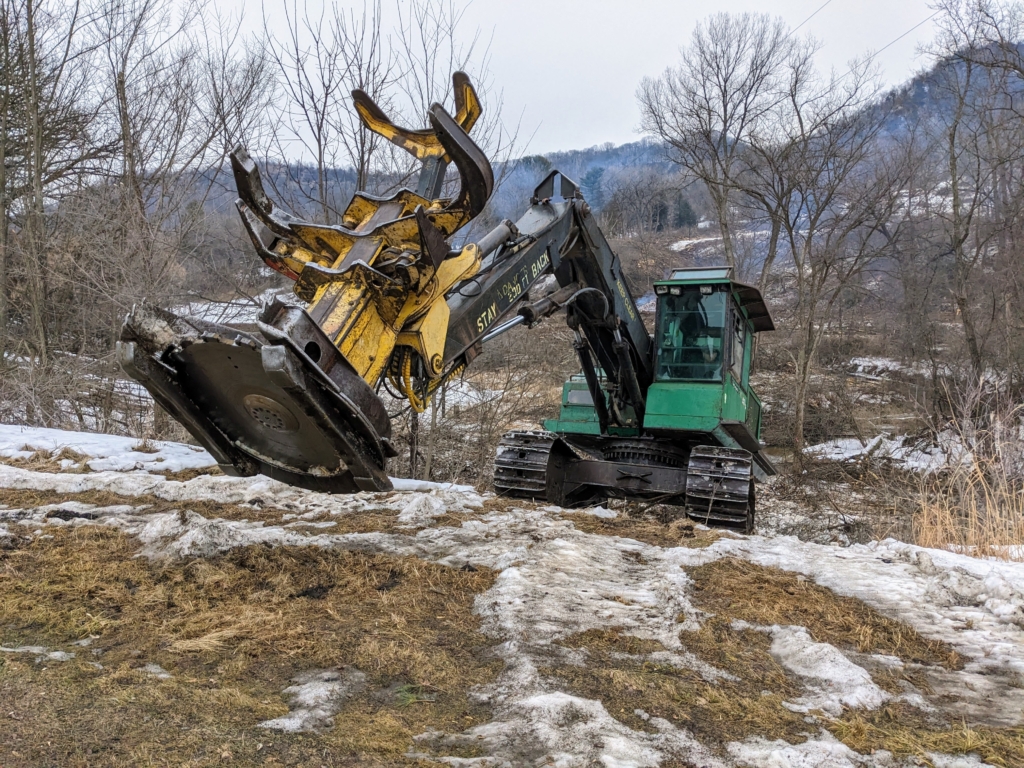
A feller-buncher used in conjunction with an additional excavator, skidder or bulldozer can leave a 10+ acre site perfectly clean in just a day or two (and that might even include burning the excess wood material and burying the ash pile). The site may look a bit like a war zone by the time the equipment is hauled off, and a bit of extra tidying up with smaller machines may be helpful, but it is sure a nice way to prepare a space for rebuilding.
Drawbacks
The greatest drawbacks of using these heaviest forms of equipment are probably the contractor cost and the temporary emotional effects the initial appearance might have on the neighbors. But vegetation will grow quite rapidly, and it won’t be long before the passers-by relax and come to appreciate your efforts.
Soil compaction from the use of heavy machines (more of an issue in the Spring, Summer and Fall) is likely to have an effect on soil health. Water, nutrient, and mineral transfer into and through the soil will be changed. Some effects on vegetation establishment might be worth consideration as well. Some soils types are less affected by compaction and, generally, equipment operating on tracks, rather than wheels, will cause less soil compaction.
When the project allows, I find feller-bunchers to be an incredible tool to quickly take a site from a totally dysfunctional, closed canopy state, to a clear, sunny site with only the few scattered savanna trees remaining (ones which you had flagged for preservation before the machines moved in).
Follow-Up
As with any of the other tools, the heavy machines can not correct the functional issues of a site on their own. Additional follow-up work will be necessary. Seed will almost always need to be installed to quickly achieve the capacity for fire and/or grazing. And then proper establishment and management practices will need to be implemented in order to ensure project success. Machines are remedial tools, they certainly shouldn’t be solely depended on to increase site biodiversity. But they can do a good job of setting the stage for it.
In the next post I will attempt to address the complicated issue of herbicide use. This series of posts can be found in the ‘Resources’ page of our website.



Leave A Comment