

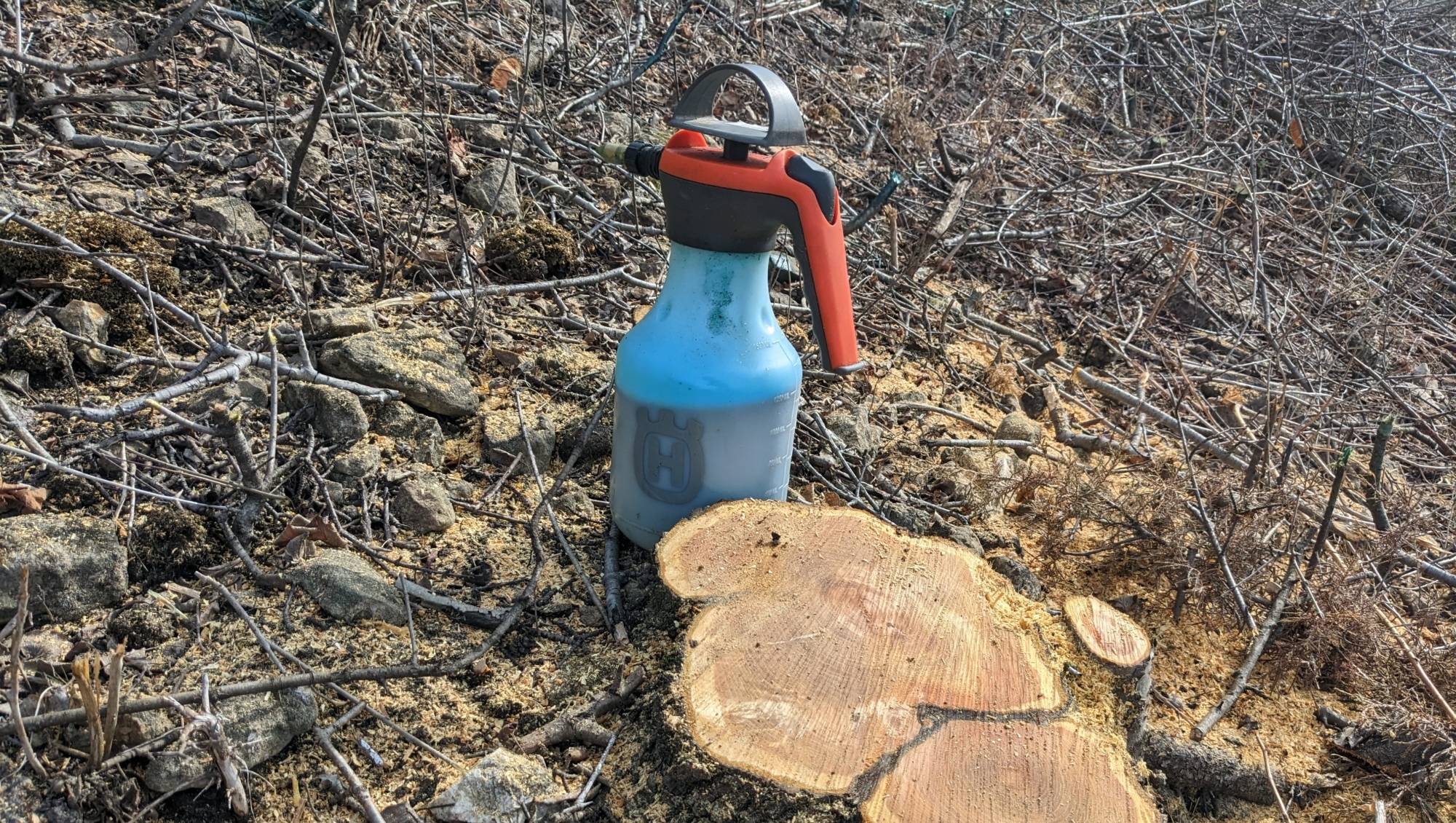
In this post I will do my best to share my complicated thoughts and feelings about Herbicides. This can be a very sensitive topic for some people. Herbicides have strong proponents and detractors across the cultural and political spectrum.
Risks
I am a certified applicator in Minnesota. I have been through the required safety training courses and am required to participate in recertification seminars every two years. I am not a chemical expert, and I don’t work for any chemical company. I am simply a practitioner attempting to make the best use of the tools that we have on hand.
There is no doubt in my mind that herbicides have risks to the environment and to my own health. Although a lot of research continues to be done on the acute environmental and health risks of herbicides (these risks are stated on the herbicide label and Material-Safety-Data-Sheets), the research is not often set up to address the potential long-term, chronic effects of their use. To make matters worse, our healthcare systems are also not incredibly well equipped to address chronic health concerns.
As someone who already suffers from some auto-immune health conditions, I am forced to maintain a pretty strict, healthy diet, and I also take a number of additional nutritional supplements. With my personal choice to continue to use herbicides I have plenty of incentive to support natural body detoxification processes, and to try to reduce my own long-term risk.
A Useful Metaphor
I like to compare the use of herbicides with the use of medical antibiotics (in reality herbicides are simply antibiotics). There are well documented risks to using medical antibiotics, e.g., the destruction of our gut microbiomes and the protective qualities of our innate immune system. In spite of this, antibiotics are clearly tools that we, at times, continue to need. When we are prescribed medical antibiotics we should use the most specific and effective kind that we have available (assuming we know exactly what we are targeting). It is prudent to cause the least amount of collateral damage possible. The same thing can be said of herbicides.
There are now a number of quite selective herbicides- ones that target broadleaf weeds, or that target grasses. There are even formulations that specifically target legumes or other specific plant groups. There are also broad-spectrum herbicides, like glyphosate, that are less precise but control a much broader variety of plant species. Sometimes we need to control many species at the same time, and sometimes we may even want to completely reset a site to start from scratch.
In spite of the bad press that RoundUp gets (as well as its risks), I still find it practical for a lot of projects. It might also be mentioned that RoundUp replaced a lot of much more problematic chemicals. And we can be hopeful that technological advances will continue to allow us to be safer and less dependent on herbicides in the future.
Use Philosophy
There is, in my mind, quite a bit of difference between using herbicides over miles and miles of food crops many times year after year, and using precise, almost surgical applications of herbicide as a ‘stepping-stone’ in a restoration project. Herbicides are used as a stepping stone when they transition us to a state where they would no longer need to be used in the future (or at least minimally used). I won’t weigh in too strongly on the agricultural herbicide uses and their risks (I certainly have my concerns), but it is a simple thing to observe that the huge expanses of land where herbicides are now applied annually are quite absent of biodiversity. That said, I’ll give a nod to my farmer friends and acknowledge that their herbicides and no-till cropping are preventing much of the erosional soil losses seen under former methods of constant tillage.
I find that most individuals, when put in the position of actually having to manage land at any substantial scale end up conceding to some degree of herbicide use. Certainly, most of the contractors doing ecological work would be frustrated if herbicides vanished from their toolboxes. There are, indeed, a few contractors doing work without chemicals using techniques like ‘high-cutting’ of buckthorn, and there is certainly room for choosing to prioritize mechanical controls over chemicals, but these alternative practices may not always be the most practical or efficient. Again, we are only ever left with trade-offs.
Site Recovery
I sometimes make the argument that when I use chemicals for site-prep prior to a native seeding, by the time my vegetation is established (usually after about 3 years), I could then certify the site for Organic agriculture. And the research I’ve read is pretty clear that native vegetation establishes much more effectively when at least one herbicide application has been applied beforehand. I know enough people who wish they would have set aside their initial anti-herbicide idealism when installing prairie because their end results did not turn out as they hoped they would. Sometimes they even decide to start the project over.
It seems to me that the rich biodiversity on a site that was prepared thoroughly, installed well, and has been managed carefully is a good argument for antibiotic use on the landscape. Is it not at least somewhat similar to healthy hospital patients being discharged having overcome some infection with the aid of medical antibiotics?
Suggestions
I don’t want to spend too much time on specifics here, because there are far too many options out there, but because people ask me all the time, I will make one small suggestion. If I were to keep only two herbicides in my kit, I would choose a glyphosate product (like RoundUp) for general broad use, and a triclopyr product (like Garlon4) for broadleaf weed and brush control. There are many different generic versions and varying concentrations out there, so it is important that you carefully read the label and follow specific instructions rather than simply relying on what a friend might be doing. Departing from specifically labeled uses is against the law.
Always wear proper PPE, and minimize your exposure to herbicides (and other antibiotics) as much as possible. Use and dispose of chemical waste and empty containers according to the instructions on the label. Avoid as much overspray on neighboring vegetation as possible, refraining from application in high wind periods or in volatile weather. Be sure to thoroughly wash your clothing (and yourself) after applications. And also be sure to keep your body, your internal organs, and your immune system as healthy as you possibly can!
In the next post I will explain the effective use of fire within ecosystem restoration and management. This series of posts can be found in the ‘Resources’ page of our website.



Leave A Comment