
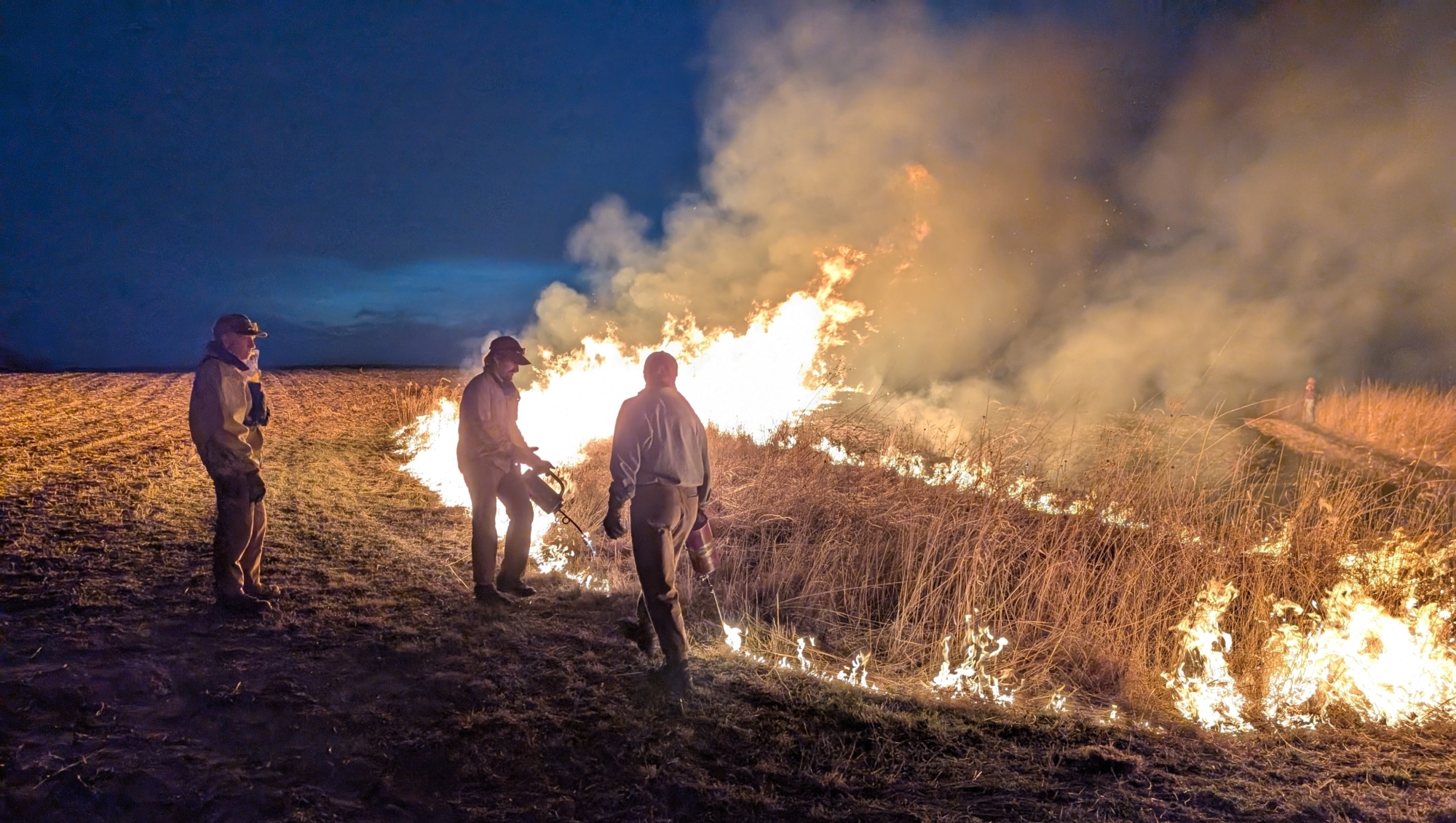
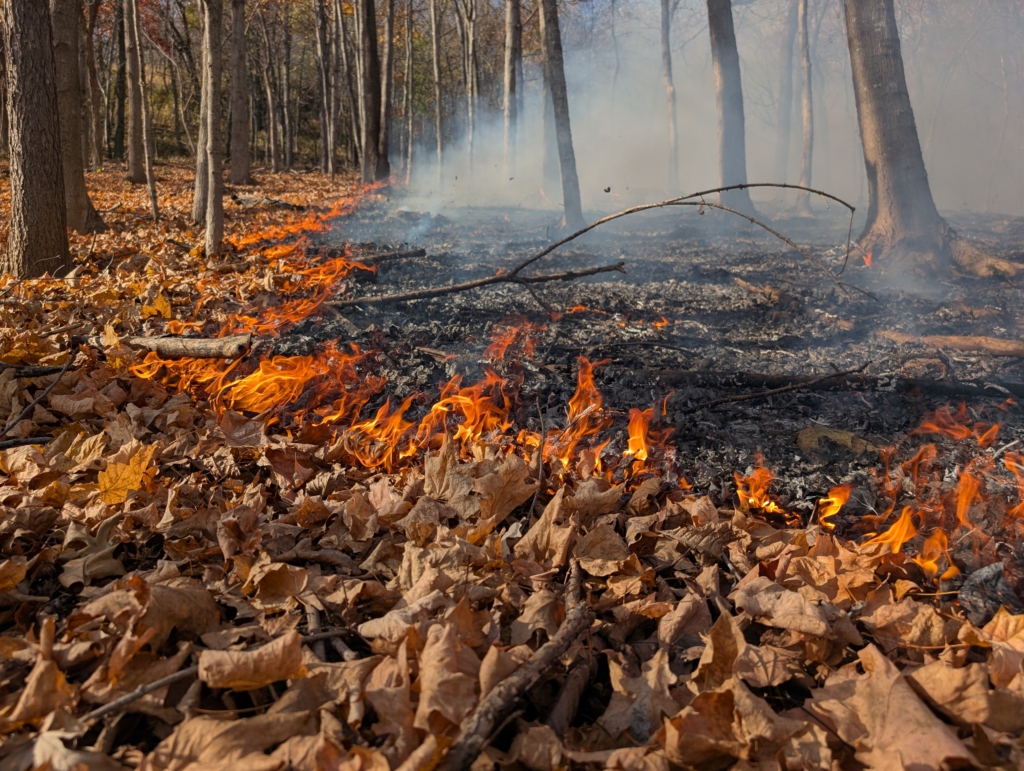
Fire is a complex tool as well as a cultural phenomenon. I’ll attempt a brief introduction to the use of fire, although anyone desiring to learn the use of fire will benefit from getting a bit of training or from participating on a burn with an experienced crew. Fire tools and techniques are beyond the scope of this format.
Indigenous Fire
Historically, in our area, fire was broadly used by Indigenous peoples as a management tool on the landscape. Fire clears ground to make travel and hunting easier, it reduces problematic woody vegetation and pest populations (even ticks). Fire stimulates the natural fungal and bacterial components within our soil and invigorates herbaceous plant growth which, in turn, attracts wildlife and provides nutritionally dense browse. Fire causes wildflower blooms to synchronize and increases pollination success and subsequent seed production. Most of our native vegetation is fire adapted (or even fire dependent), and without fire these species diminish.
Fire Today
Nowadays fire suppression is the status quo. News of extreme fire events in other parts of the country leave the public unsettled, prone to calling the fire department at any sight of flame or smoke in a natural area. That said, there is a recent renewed interest within environmental, conservation, and even hunting circles around the benefits of prescribed fire and the importance of fire risk mitigation in our natural areas. In spite of these encouraging trends, it can still be difficult to avoid inducing a local panic when uninformed passers-by observe fire where they don’t expect it.
‘Prescribed’ fire is a title we have given to the intentional application of fire as a management tool. I use this term frequently, but am aware of its shortcomings. I think that it would be appropriate for us to acknowledge fire as a deeply traditional natural ecological process that we participate in. It is easy to, instead, fall into the pattern of treating fire as something we ‘do’ or something we ‘perform’ on the land as an external distinct force. Our community and ecosystem will surely benefit if we can redevelop a more cultural and integrated practice of fire more along the lines of what Indigenous peoples had. This takes serious investments in time, experience, observation, and relationship building.
Fire Here
In our area, we are surrounded by mostly degraded ecosystems that would have burned much more consistently in the past. These systems often now fail to carry flame no matter how hard we might try. The losses of our native grasses, sedges, wildflowers, and even our oak trees are signs that we are losing our burn-ability along with our biodiversity. The topography of the Driftless region impedes a fire’s ability to spread broadly across the landscape. The current state of our North slopes make them largely unburnable. Once a fire reaches the top of a bluff and begins to crawl down a more northerly slope, it almost always goes out from either a lack of fuel, or an increase in fuel moisture and humidity. Evenings and nights in our area almost always see a notable increase in humidity, thus serving to suppress the spread of fire. And when woodland tree canopies begin to swell in the spring, fire becomes increasingly unlikely.
It is certainly still possible to have impressive fires here, but our context is quite a bit different than the dry west, or even the coniferous north of our own state. These characteristics can help to make our burns safer to carry out, but they also limit the extent to which we may be able to re-integrate fire.
Fire Conditions
Fuels have a strong effect on how well fire will carry, but to those without much experience, weather often has a much more startling effect. Leaves and grasses can reach equilibrium with the ambient humidity in roughly one hour. These are called ‘one-hour fuels’. Twigs, sticks, logs and stumps have increasingly lengthened drying times. A fire on a dry, warm, and windy day is an entirely different character than a fire on a high-humidity, cool day. Fuel loads being equal, the difference of a few percentage points of humidity can make all of the difference between an easy-to-control fire, and one that you are desperately struggling to contain. Experience is truly the key to being able to predict this variability.
Management Goals
The long term goal in most of my work is to achieve a functional state that can be maintained with fire instead of with heavy equipment, chemicals, and countless hours of annual physical labor. I am constantly thinking about the properties I maintain in terms of where the firebreaks are, and how existing human infrastructure will need to be protected. Due to our topography, it is often easier to manage entire bluffs than to attempt to divide management practices at arbitrary property lines. We need to learn to collaborate more with our neighbors because there are too few prescribed fire contractors out there. Our burn seasons are too brief to fulfill the ecological needs of our current landscape and we simply need more people to take the initiative to learn how to apply fire themselves.
I’ll now provide one caveat: it is important to be aware that some of our populations of threatened and endangered species are quite fire sensitive, in spite of their general dependence on fire adapted ecosystems. A number of invertebrates, reptiles and terrestrial snails fall into this category. When possible, it can be helpful to maintain unburned areas as ‘refugia’ (safe-havens) for these species. It is not necessary to make sure that every square inch of a site burns in each fire event (even if our psychology sometimes urges us to see that it does). Where sensitive species may exist, it may be warranted to carve out some space protected from fire from which these species can repopulate the landscape.
Fire Resources and Training
The recently formed Minnesota Prescribed Fire Council is a good place to learn a bit more about fire in Minnesota. If you can find a local chapter of a group like The Prairie Enthusiasts, you can get involved in prescribed burning as a volunteer, as well gain classroom knowledge in courses hosted multiple times a year. If you are near the Winona area, you are also welcome to reach out directly through the Restoravore website and ask to be put on our volunteer list. We have a few burns that we participate in as a community each season. The more people we can engage in fire management, the more exponentially our effects on large-scale landscape revitalization will grow.
This series of posts can be found in the ‘Resources’ page of our website.


Leave A Comment